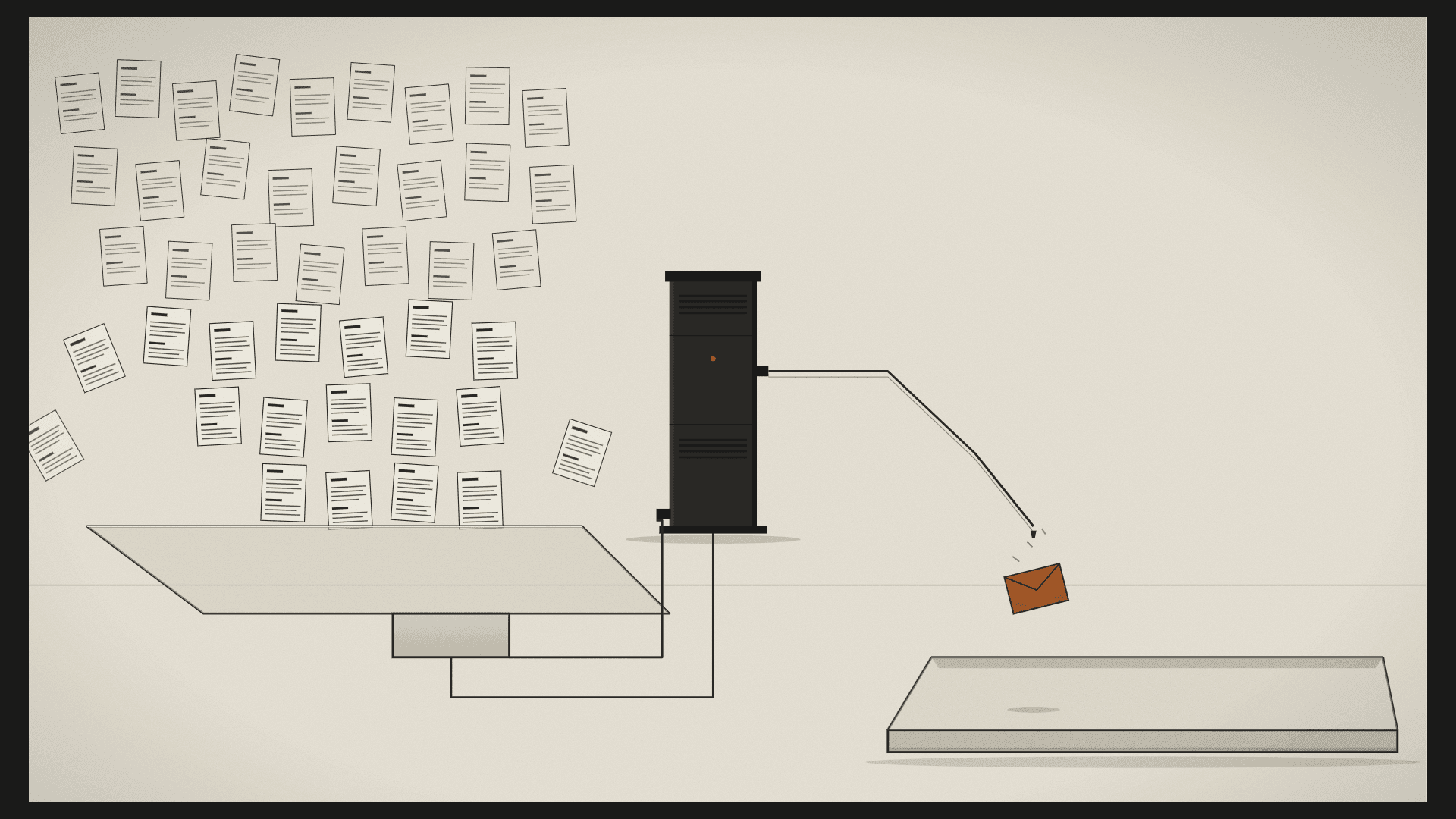
Did SaaS really change the world for the better? Case in point: the applicant tracking system.
You uploaded a resume. You got an auto-reply. Then weeks of nothing.
What does the ATS actually do?
ATS stands for applicant tracking system. It's the software a company uses to take in job applications.
You hit apply on a careers page. Your resume goes into a database. The system parses it for skills and keywords, then ranks you against the role. A recruiter or hiring manager pulls a shortlist from the top.
That's the whole product.
You've probably typed into one without realizing.
Greenhouse. Workday. Lever. Ashby.
Most Fortune 500 careers pages are a thin skin over one of them. Roughly 75% of recruiters use one (SAP).
On paper, that's a market doing its job. Software replaced spreadsheets, order replaced chaos, companies pay and work gets done.
It hasn't actually made hiring better.
Why does applying for a job feel like screaming into a void?
You've felt it. Most people have.
You spend an hour tailoring a resume. You answer twelve questions about whether you can lift twenty pounds. You upload the same document the parser already chewed up. You hit submit.
Auto-reply lands in your inbox saying we've received your application.
Then silence. Three weeks. Six weeks. Forever.
Search r/recruitinghell for five minutes and the same post repeats with different usernames. X is full of founders posting ATS rants while recruiters defend the tool underneath them. Candidates pile up in the replies asking when, exactly, anyone will hear back.
The metrics tell the same story. Time-to-hire is up. Application volume per role is up. Candidate-experience scores are down.
Thirty-five years of "innovation" later and the loop is more broken, not less.
Software didn't make hiring more human. It made it cheaper to be inhuman at scale.
Wait, is the ATS rejecting my resume?
Probably not. This is one of those things everyone "knows" that turns out to be wrong.
You've heard the stat. 75% of resumes never reach a human. Robots are killing your career. The fix is some PDF-formatting trick or a stuffed-keyword resume that "beats the system."
The 75% number is fake. It came from a 2012 sales pitch by a startup called Preptel, which sold resume-optimization services. They went under in 2013.
No study, no methodology, just a slide that sounded right and sold things. The stat got reprinted everywhere because it sounds true and it sells stuff (HR Gazette; ResumeAdapter, 2026).
A 2025 Enhancv study found 92% of recruiters say their ATS does not auto-reject resumes. Only 8% of companies even configure content-based auto-rejection. The software is sorting. It's not killing.
So what's actually happening?
A human is. A human who got 200+ applications and opened a dozen. A human juggling eight open roles who can only seriously consider thirty candidates total. A human whose ATS makes it incredibly easy to do exactly that.
The algorithm didn't ignore you. A human did. The system in front of them was designed to make ignoring easy.
So who is the ATS actually for?
Run through any ATS feature list and ask one question. Whose day does this make easier?
- Five-stage candidate pipelines
- Scorecards for collaborative debrief
- Requisition approvals that route through six executives
- Source attribution
- Interview kits
- Auto-sequenced rejection emails
- A unified inbox where every candidate conversation lives next to every other candidate conversation
Every one of those is a recruiter task made faster. None of them is a candidate experience made better.
The pricing says the same thing. Greenhouse costs roughly $6,000 to $40,000 a year (Leonstaff). Lever can run up to $144,000 for larger teams (Pin.com). Workday Recruiting, bundled into a wider HCM deal, lands somewhere between $100,000 and $300,000 a year (Monetizely).
This is software priced for organizations that employ professional recruiters. It is recruiter productivity software. It was never sold to "the candidate" or even to "the founder who just needs a developer."
So when SaaS pitched this category as transform hiring, what it actually meant was transform the recruiter's afternoon.
That's a fine product. It's also a different product than the one the marketing copy implies.
Candidate experience didn't break despite the spend. It broke because the spend was never trying to fix it.
A small footnote before we keep going. There's a quiet, growing group of platforms built on the opposite assumption: that the hiring manager is the customer, not the recruiter. Maazi is one of them. More on that another day.
Why has the same shape lasted 35 years?
Resumix shipped the first resume-parsing software in 1988, out of Santa Clara. The first web-based ATS hit in 1996. Every generational shift since has kept the same pipeline.
SaaS in the 2000s. Cloud in the 2010s. AI and LLMs now.
Ingest. Parse. Rank. Surface to a recruiter.
The technology changed five times. The customer didn't.
This is the boring law of SaaS that nobody puts in a pitch deck. Products take the shape of their buyer. The buyer of ATS is, was, and largely remains the recruiting function inside a company.
So the product solves recruiting-function problems. Faster sourcing, cleaner pipelines, better reporting to the head of TA.
Categories cannot fight their own buyer. An ATS vendor cannot ship a product that makes the recruiter unnecessary, because the customer would stop paying. That isn't a conspiracy, it's just economics.
You don't get hiring software that serves the candidate until somebody else starts paying for it.
What does hiring look like when the decision-maker is the customer?
Different shape entirely.
The product stops being a pipeline. There's nothing to manage through stages, because there's no funnel-mover sitting in the middle. The hiring manager doesn't need a scorecard for collaborative debrief because there's no separate team to align with.
Screening delivers something closer to a shortlist than a pipeline. The output is here are the four people you should talk to. Not here are 247 candidates organized into a Kanban board for you to triage.
Candidate communication stops being an auto-sequence built to keep applicants warm while a recruiter works through 200 other names. It turns back into a real loop. The person screening and the person deciding are the same person. That person has an actual reason to close.
The black hole disappears. Not because some algorithm got smarter, but because the reason the black hole existed in the first place is gone.
This is the wider lesson worth taking from the SaaS story. Products are the shape of the people who pay for them. If you want different products, the answer is rarely "better software." It is usually "different customer."
The ATS is not broken. It is doing exactly what its customer asked for. The question is whether that customer should be the one in charge of the candidate experience at all.
SaaS did change the world. Just not always for the people the marketing pretended it was for.
Next time you apply for a job and hear nothing, that's not a bug. It's the product working as designed. For someone else.